Introduction
Integrated service delivery can help make HIV prevention more accessible, convenient and responsive to people’s broader health needs. By integrating HIV prevention with sexual and reproductive health (SRH) and other primary healthcare services, clients can access multiple services through a single point of care, reducing the need to navigate separate programmes and service delivery points.
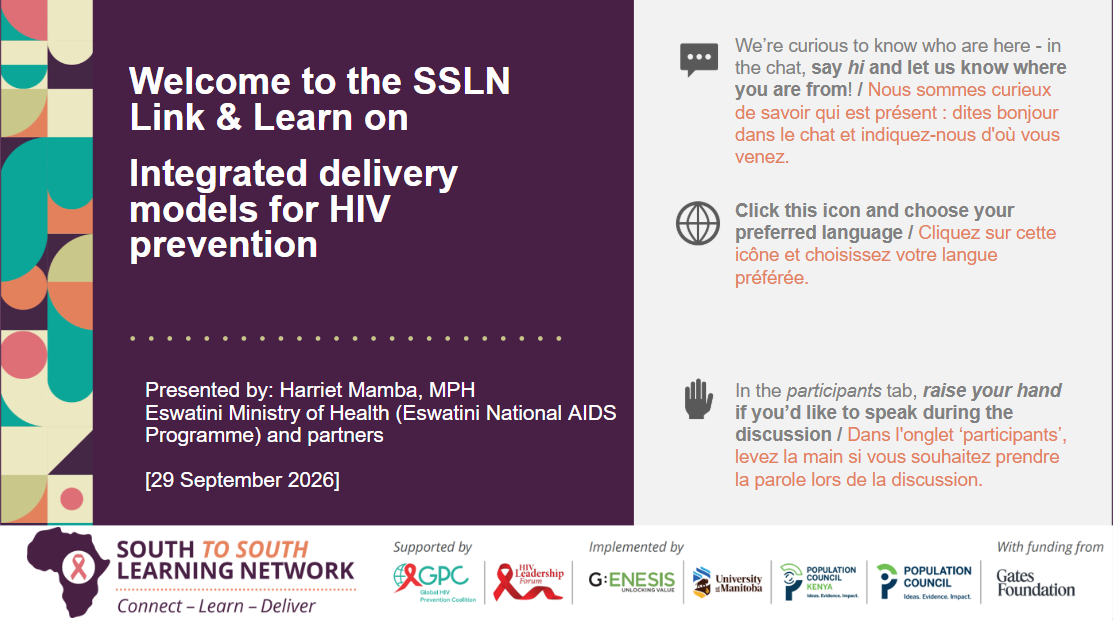
The Link & Learn session hosted by Eswatini explored the country’s experience in developing and implementing integrated delivery models for HIV prevention. The session focused on Eswatini’s one-stop approach, which brings HIV testing and prevention together with SRH and other health services, and highlighted the lessons, opportunities and challenges associated with integrating services across different levels of the health system.
Objectives
- Explore Eswatini’s approach to integrating HIV prevention with SRH and other health services.
- Share practical experiences and lessons from implementing integrated, client-centred service delivery models.
- Demonstrate how different HIV prevention options can be incorporated into existing health service delivery points.
- Discuss the enabling factors and challenges associated with integrating services across primary healthcare, health centres and hospitals.
Proceedings
Harriet Mamba, Eswatini National AIDS Programme, presented the country’s experience with integrated delivery models for HIV prevention, with a focus on the one-stop model. She explained that the approach brings HIV testing and prevention together with SRH and other health services, helping to address the fragmentation of services that previously resulted in missed opportunities, multiple queues and appointments, and stigma associated with accessing HIV-specific services. Integration has enabled clients to access a broader range of services through a more convenient and client-centred approach.
Harriet also highlighted Eswatini’s experience integrating different HIV prevention options into routine health services, supported by updated policies and guidelines, trained healthcare workers and approaches tailored to populations at higher risk of HIV. She reflected on the importance of adapting service delivery to client needs and learning from implementation experience, while acknowledging the challenges encountered in integrating services. The presentation provided practical lessons for participating countries on the factors that can enable integrated prevention services and opportunities for continued South-to-South learning.
The session provided an opportunity for participating countries to reflect on how Eswatini’s experience could inform their own approaches to integrated HIV prevention. A key lesson was that integration is not a single model that can simply be replicated across countries. Rather, countries can adapt different approaches according to their health system structures, available resources, service delivery points and the needs of their populations.
Resources
Access the recording and presentation materials from this session for further insights and information.
Download Event Material