Introduction
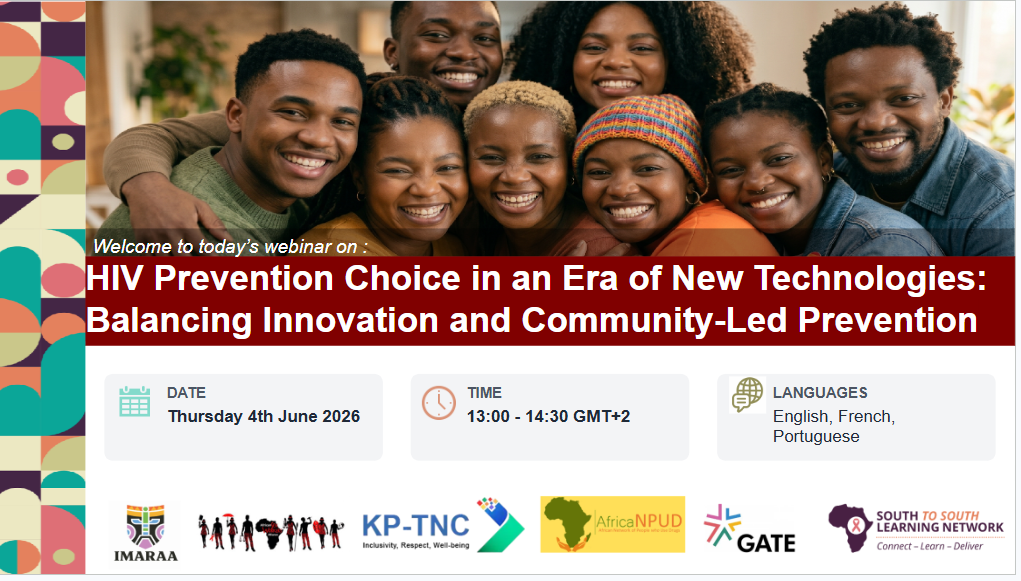
The South-South Learning Network (SSLN) recently hosted a vital webinar, “HIV Prevention in an Era of New Technologies: Balancing Innovation and Community-Led Prevention.” Convened in partnership with IMARAA, ASWA, AfricaNPUD, GATE, and the Key Population Transnational Coalition, the event drew vibrant participation from diverse key population networks and community-based organisations.
It was the overarching goal of this webinar to highlight that as the world embraces brilliant biomedical innovations, we should not lose sight of the community-led, rights-based approaches that actually make these technologies work on the ground. The webinar focused on key population network members, providing them with a safe space to discuss issues, share experiences, and use the learnings to advocate for their needs in their respective countries.
The webinar combined expert inputs, country-level community perspectives and panel discussion, focused on shifting from discussion to driving real-world outcomes.
Key Highlights
- Opening and Framing: The webinar chair, Ahmed Said (AfricaNPUD) welcomed everyone to the session and implored the participants to participate actively in the webinar while highlighting the relevance of the focus of this webinar at this time.
- WHO Normative Guidance on Services for Key Populations: Clarice Pinto (World Health Organization) shared WHO’s normative guidance on services for key populations which is grounded in community empowerment and leadership. She emphasised that the guidance positions peer-led and community-led models like task sharing with lay providers, multi-month refills, and community pick-up points at the heart of effective health service delivery. She advocated for a balanced combination of direct health interventions alongside essential enabling interventions designed to proactively reduce stigma, violence, and punitive legal barriers to achieve sustained impact and ensure equitable access in the changing funding landscape.
Evidence and integration of prevention approaches:
- Carel Pretorius (Avenir Health) delivered a presentation on modeling approaches to HIV prevention response. He introduced the Goals model, a compartmental HIV epidemic model developed with support from UNAIDS, WHO, the Global Fund, and the Gates Foundation, which simulates epidemic dynamics to estimate the distribution of new infections, programme impact, target costs, and the cost-effectiveness of interventions. He also emphasised that while strategic modeling is critical for resource advocacy and decision-making, the planning of prevention programmes for key populations is sensitive to uncertain parameters and should not be based on cost-effectiveness analysis alone, but must heavily incorporate considerations of equity, sustainability, and community engagement
- Heather-Marie Ann Schmidt (Global HIV Prevention Coalition) presented a prioritised approach to HIV prevention aligned with the "HIV Prevention 2030: A Global Access Framework for Country-Led Responses". She explained that the framework leverages the Global AIDS Strategy (GAS) 2026–2031 targets, introducing a systematic and granular approach to estimating prevention needs with direct relevance to Grant Cycle 8 (GC8). She also mentioned critical programming briefs, frameworks, and tools to assist countries with implementation. Foremost among these was a person-centered prevention framework built on the "5 Ps of prioritisation": People, Places, Packages, Platforms, and Prices. This model emphasises designing strategies around people’s actual realities rather than centering on products, utilising an optimal mix of biomedical, behavioral, and structural elements.
- Anil Padavatan, Global Action for Trans Equality(GATE), addressed the critical stakes for HIV prevention in a changing global context, sharing that reduced donor funding has introduced strategic shifts that risk deprioritising prevention and creating an overly medicalised focus at the expense of balanced key population programming. Anil suggested that community-led networks must equip themselves with data to support strong advocacy, noting that while global HIV incidence is decreasing, UNAIDS data reveals rising incidence specifically among trans women and men who have sex with men. Anil also detailed five core suggestions for youth-led networks, demanding formal representation with voting power on CCMs, dedicated funding streams to combat unequal participation, structured youth-led monitoring, early technical capacity building, and inclusive equity that intentionally encompasses young key populations and rural youth. Anil also shared the Joint Communities Guide on Global Fund Grant Cycle 8 and the Peer-Led Approaches for HIV Prevention for Key Populations.
Understanding funding for HIV Prevention:
- Maria Phelan (The Global Fund) shared the strategic shifts for Grant Cycle 8 (GC8) aimed at steering countries toward self-reliance. She highlighted that GC8 explicitly emphasises reducing access barriers by integrating interventions that tackle human rights and gender-related structural obstacles. She also advocated for the strengthening of community organisations through capacity building for social contracting and formal primary health care linkages, while community-led monitoring (CLM) should be institutionalised into national quality assurance systems. Finally, she introduced the upcoming updates to the Community Engagement Toolbox which includes new resources on sustainability, transition, and service integration and recommended that platforms be strengthened to enable meaningful community engagement in health decision-making and national governance processes.
Panel discussion on strengthening meaningful engagement and impact:
- Solomon Wambua (KP Transnational Coalition), facilitated the panel discussion with leaders from country KP networks including Marineus Mwombeki (Tanzania), Rita Gatonye (WRADA, Kenya), Watara Yahaya (Ghana) and Jay Mulucha (Uganda). Panellists shared their experiences, current environment for KP programming at community and country levels including anti-homosexuality laws/policies, barriers to healthcare services, mistreatment, stigma and discrimination/exclusion, fear, despite the introduction of long-acting prevention methods, subsequently affecting meaningful engagement adversely. They also shared their experiences and advocated for meaningful engagement and inclusion in decision-making processes and urged the participants to continue pushing on, speaking up and telling their stories. As Jay Mulucha said, “Stories are powerful but stories supported by evidence are even more powerful”.
Closing/Call to Action:
The webinar concluded with closing reflections facilitated by Humphrey Ndondo of IMARAA, reinforcing the central message that HIV prevention in the era of new technologies must remain both innovation-driven and community-led.