Introduction
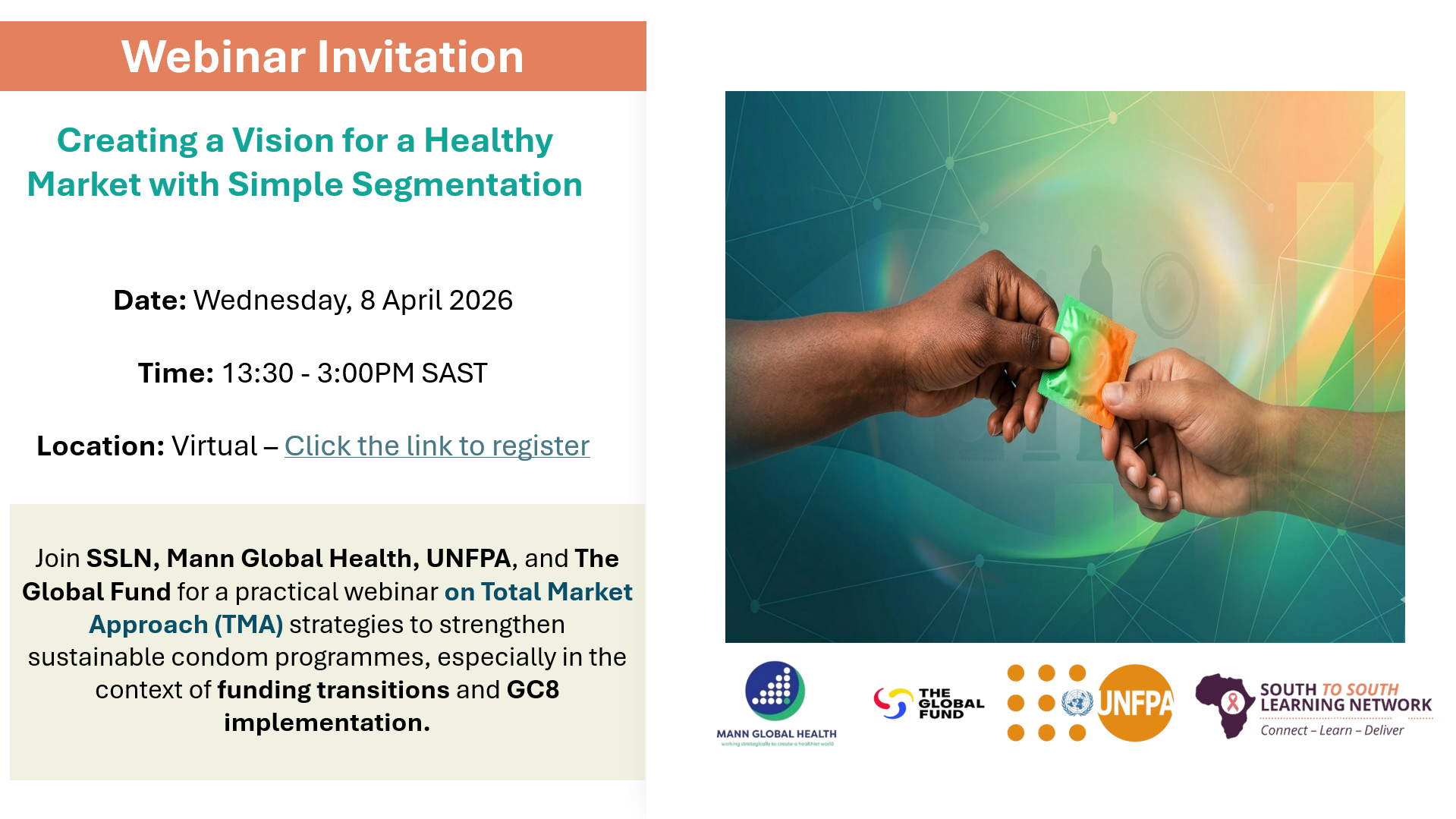
This webinar marked the second session in a three-part series on applying the Total Market Approach (TMA) to strengthen sustainable condom programs in the context of funding transitions and Global Fund Grant Cycle 8 (GC8). The session focused on equipping national programs and technical stakeholders with practical tools and approaches to improve market efficiency, ensure equitable access, and reduce reliance on donor subsidies.
The session emphasised the importance of simple market segmentation, particularly by risk and ability to pay, as a foundation for designing a healthy condom market. It highlighted how aligning public, social marketing, and commercial sectors can support a balanced system where free condoms are targeted to priority populations, while the private sector serves those with the capacity to pay.
Objectives
The webinar aimed to:
- Strengthen understanding of how segmentation supports a sustainable and well-functioning condom market
- Demonstrate how risk and ability-to-pay segmentation improves targeting of free condoms
- Introduce demand-based quantification using the Condom Needs Estimation Tool (CNET) to inform procurement
- Highlight implications for GC8 proposal design, budgeting, and long-term sustainability
Proceedings
The session was chaired by Rosemary Kindyomunda (UNFPA), who opened the webinar and welcomed Ayesha Ismail (Genesis Analytics). Ayesha provided an overview of how the webinar series aligns with SSLN’s broader objectives of promoting South-to-South learning and the practical application of Total Market Approach (TMA) principles.
A presentation by Carla Rodrigues (The Global Fund) highlighted the growing importance of sustainable commodity markets in the face of declining donor resources. The discussion linked these challenges to GC8 priorities, particularly in procurement planning, budgeting, and ensuring long-term program viability.
Technical insights shared by Chris Jones (Mann Global Health) focused on creating a vision for a sustainable condom market. This included:
- Introducing the Condom Needs Estimation Tool (CNET) to align supply with actual condom use
- Demonstrating how segmentation by risk and ability to pay informs market structure
- Clarifying the roles of free versus sold condom markets
- Exploring how distribution channels can support targeted access
A panel discussion featuring country representatives Anna Machiha (Zimbabwe) and Bertha Sato (Malawi) provided practical examples of how segmentation is being applied in real-world settings. Panelists discussed how these approaches inform procurement decisions, improve targeting strategies, and support market shaping within GC8 proposals. Key themes included balancing equity with sustainability, managing supply constraints, and adapting to reduced external funding.
The session concluded with an interactive question and answer segment, followed by closing remarks reinforcing the importance of data-driven decision-making and cross-sector coordination.
Resources
Please find the recording and slides from this session below.
Download Event Material