Introduction
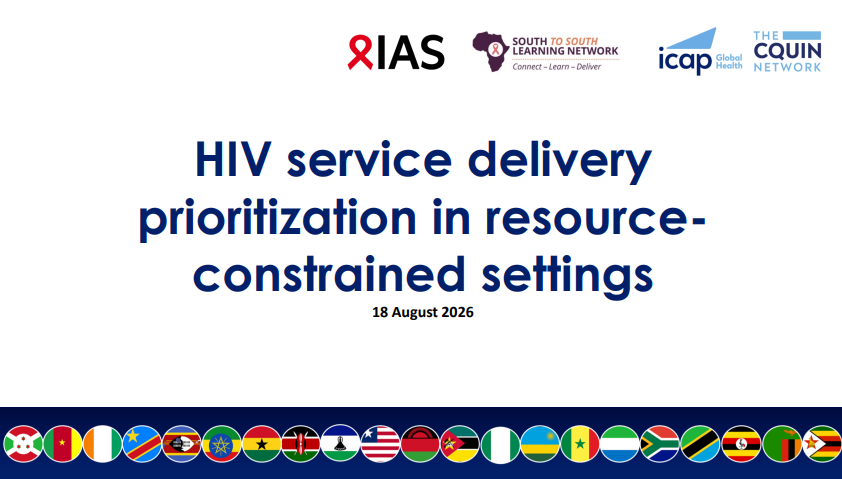
On 18 August 2026, the International AIDS Society (IAS), ICAP-CQUIN at Columbia University, and the South to South Learning Network (SSLN) jointly hosted a webinar on HIV service delivery prioritisation in resource-constrained settings. The session built on discussions from the 26th International AIDS Conference 2026, which took place a month prior, and brought together ministries of health, civil society and technical partners to dig into a question every HIV programme is now facing: with fewer resources, what gets protected, what gets adapted, and what gets dropped?
Objectives
The webinar aimed to:
- Make the case for why ongoing, iterative prioritisation is now a permanent feature of HIV programming, not a one-off response to a funding shock
- Share lessons from CQUIN's 2025 prioritisation exercises across its member countries
- Introduce TIER-Plus, IAS's new decision-support tool for modelling the cost and epidemiological trade-offs of different service configurations
- Hear Mozambique's first-hand experience piloting TIER-Plus to inform national planning
- Introduce the SSLN's Insight 2 Implementation (i2i) resources, namely the HIV Data Decision Maker and the Tobi chatbot to help countries turn evidence into action
Proceedings
Maureen Syowai (Programme Director, ICAP in Kenya) opened up the session by welcoming the hosts and presenters of the webinar.
Anna Grimsrud (IAS) opened by reframing the moment: rather than treating recent funding disruptions as a passing storm to weather, she argued programmes need to plan as though this is a lasting shift in climate. She traced the evolution of IAS's prioritisation tools from the original TIER (Tool for Intervention Evaluation and Ranking), used in some form by at least 21 countries, and adapted by COMPASS partners into a "TIER–Community Prioritization Tool" covering HIV, TB, malaria, NCDs and pandemic preparedness. In Tanzania, for example, community service organisations used their own version of the tool to engage the Global Fund, PEPFAR and government on prioritisation. The recurring piece of feedback on the original TIER, she noted, was that it could help identify priorities, but it couldn't quantify their impact.
Tier-Plus was developed because countries were asking the question: “Tier helps us to identify our priorities, but how do we estimate what happens when we act on them?”. Tier-Plus does this by allowing stakeholders to compare scenarios, estimate outcomes, and understand trade-offs.
Onyekachi Ukaejiofo (CQUIN, ICAP at Columbia University) walked through the scale of the 2025 funding shock. A more than 50% reduction in US government external HIV funding, alongside an average 11% reduction in Global Fund awards. In response, CQUIN supported ministry-of-health-led prioritisation exercises across its network. Countries gathered documentation, held one-day deliberation meetings using a CQUIN-modified TIER tool, and had their submissions validated and summarised to support interpretation. An initial round of scenario discussions ran from July–September 2025 across 14 countries, expanding to 21 countries by October–November as Global Fund grant revisions and PEPFAR bridge funding allocations came through.
Some clear cross-cutting findings have emerged:
- Prevention: Facility-based infant prophylaxis (especially for high-risk infants in the first six weeks) and PEP stayed as consistently high priorities, while virtual PrEP refills and some out-of-facility DSD models were downgraded later in the year.
- Testing: Facility-based testing linked to ANC, TB, STI and malnutrition services, plus testing for HIV-exposed infants and symptomatic individuals, remained strong priorities, while virtual and community-based self-testing platforms were deprioritised between October and November.
- Treatment: Uninterrupted ART, initiation across all populations, and viral-load monitoring for treatment failure remained as high priorities, while out-of-facility models saw more variable, and in some cases declining, prioritisation.
Ukaejiofo summarised six key lessons: i) countries are treating this as a strategic turning point rather than a temporary disruption, ii) treatment and essential care remain the non-negotiable core, iii) domestic financing will grow but gaps will persist, iv) technical assistance is shifting toward financing, systems and government-led models, v) sustainability and government ownership are now central to planning, and vi) equity safeguards are needed to prevent widening gaps for underserved groups.
Looking ahead, he recommended that countries should continue to conduct structured prioritisation using improved Tier tools, like Tier-Plus, supported by multi-strakeholder engagement.
Chantalle Okondo (Population Council Kenya on behalf of the SSLN/i2i) introduced i2i's role in helping countries move from data to information to evidence to action. She described two resources built directly from country stakeholder workshops: 1) the HIV Data Decision Maker (HIV DDM), a navigable guide to existing datasets and toolkits organised around programme planning and M&E questions; and 2) Tobi, an AI-powered chatbot that answers HIV programme questions in real time using a curated, restricted knowledge base of UNAIDS technical guidance, WHO consolidated HIV guidelines, PEPFAR MER indicators and EHE data tools, national strategic plans, HIV M&E guides such as PHIA and DHS, and peer-reviewed literature.
Okondo emphasised the usefulness of these tools as a consolidated, searchable resource hub for data needs. She closed by inviting participants to reflect on their own country's data needs, including resources they'd like added to Tobi's knowledge base, and where SSLN–i2i support would be most useful.
Brooke Nichols (Boston University) then demonstrated TIER-Plus itself. Tier-Plus is IAS's HIV Intervention Impact Calculator, built for national HIV programme stakeholders supporting annual budget allocation. The tool follows four steps: orientation, inputs (selecting a country and confirming or editing baseline epidemic parameters and intervention coverage across prevention, testing, treatment monitoring, retention and advanced HIV disease services), building scenarios (adjusting coverage of different interventions to compare against baseline), and outputs. Those outputs include progress against the 95-95-95 targets, projected epidemiological outcomes (new acquisitions, infant infections, HIV-related deaths), changes in the HIV care cascade, and a full cost breakdown by programme area. User can see, for example, that reducing condom distribution while increasing Lenacapavir coverage, or halving community testing, produces different trade-offs in both cost and projected outcomes.
Nichols was candid about the tool's boundaries. TIER-Plus can support national-level decision conversations, show impact across the cascade of multiple interventions, and give a relative sense of the cost and outcome implications of different choices, but it cannot generate exact costs for budgeting, produce long-term epidemic projections, replace intervention-specific planning tools (such as DMPPT or PrEP-it), or model integration with other health services. Baseline data currently covers 13 countries with values reviewed and updated by in-country teams, and several more using publicly available data and literature.
The tool has already been through a pilot phase with teams from Zambia, Malawi and Mozambique, which led to changes including PrEP targeting by sub-population, an option for 6-monthly versus 12-monthly clinical visits, cost breakdowns by category, and the ability for users to override default cost and effectiveness assumptions. Feedback since launch has generated a long list of potential next steps, including adding more countries, third scenario options, subnational models, and multi-year projections. As Nichols put it, TIER-Plus is a living tool, and the team is actively seeking feedback to keep improving it.
Irénio Gaspar (Ministry of Health, Mozambique) grounded the discussion in country reality. Mozambique manages one of the world's largest HIV programmes and remains heavily dependent on US government and Global Fund financing at a time when that financing is shrinking. As the country moves toward more government-led, integrated and sustainable service delivery, the Ministry of Health is having to balance HIV investment against broader health priorities, while facing persistent geographic and population inequalities and limited granular cost and impact data to inform difficult choices.
Gaspar described why Mozambique joined the TIER-Plus validation process: to test a transparent, evidence-informed way of comparing interventions and investment scenarios, to generate timely insight into how prioritisation decisions affect costs, outcomes and epidemic control, and to make sure the tool reflects Mozambique's own data and realities as it's refined. The country used TIER-Plus alongside its existing national prioritisation process of engaging the Ministry of Health, provincial teams, donors, partners, civil society and PLHIV networks to protect essential services, target investment where epidemiological need is greatest, compare funding scenarios, support transition planning, and strengthen the evidence base for decision-making.
TIER-Plus supported iterative prioritisation as funding assumptions have changed through the year, strengthened evidence-informed decisions by estimating potential health impact, gave government, donors, partners and civil society a shared evidence base for discussion, and fed directly into resource allocation and transition planning.
Gaspar's lessons echoed a theme running through the whole session, which is that prioritisation works best when it is country-led with modelling complementing rather than replacing programme experience. Stakeholder engagement builds trust and ensures transparency so that decisions are easier to accept.
Next steps for Mozambique include validating the tool against updated national data, applying it to live resource-allocation and donor-transition decisions, and continuing to feed back on assumptions, costs and feasibility.
Following the technical presentations, Clarence Mademutsa (Zimbabwe National Network of People Living with HIV), Simon Sikwese (Pakachere Institute for Health and Development Communication, Malawi) and Suilanji Sivile (Ministry of Health, Zambia) shared early, country-level reflections on applying these prioritisation approaches on the ground.
Country representatives were asked, “Having gone through the Tier-Plus process, what were the learnings about the tool itself or about prioritisation more broadly?”
Suilanji shared that Zambia’s key lesson was that prioritisation should be flexible. Initially prioritisation was treatment as an in-and-out process where one programme is dropped in the place of another. Tier-Plus promises a numerical rise of fall related to both the financial and to the impact. This has helped to support GC8 grant applications and writing of National Strategic Plans.
Clarence reshared Zimbabwe’s reflections in using Tier-Plus, emphasising it as a simple and user-friendly tool that all stakeholders can use, including himself as a community stakeholder. He appreciated that Tier-Plus demands that everyone come together to discuss the evidence and impact that can be reached. Simulations of the Tier-Plus tool showcased the hard truths that can give stakeholders a reality check around what works and what doesn’t.
Simon shared the challenges experienced in Malawi as a result of Tier-Plus launching at a time when their National Strategic Plan was already under review. This disconnect in timelines was a missed opportunity to make best use of the tool. He echoed the other country representatives, stating that Tier-Plus is helping to move from anecdotal advocacy to data-driven advocacy, particularly during deliberations between government and CSOs.
The session closed with a moderated panel discussion and audience Q&A involving all presenters alongside Alex de Nooy (Amsterdam University Medical Centre), moderated by Anna Grimsrud and Onyekachi Ukaejiofo.
Closing remarks shared by Ayesha Ismail (SSLN/i2i, Programme Director), emphasised the importance of prioritisation as an iterative process that needs to be grounded in real-country experience. To quote Ayesha, “Programmes are stronger when they learn from one another, when they adapt to evidence, when they’re pragmatic, and when they adapt as the landscape shifts”. As a peer learning network, SSLN exists to support this together with translating evidence into action.
Languages
The webinar was conducted in English, with simultaneous interpretation provided in French and Portuguese, reflecting the cross-regional audience of ministries of health, implementing partners and community organizations who joined the session.
Resources
The recording, slides, and summary from this webinar are available on the IAS+ platform:
View the recording, slides, and summary in English, in French and in Portuguese.
This webinar was jointly organized by IAS, ICAP-CQUIN at Columbia University, and the South to South Learning Network (SSLN).
Download Event Material