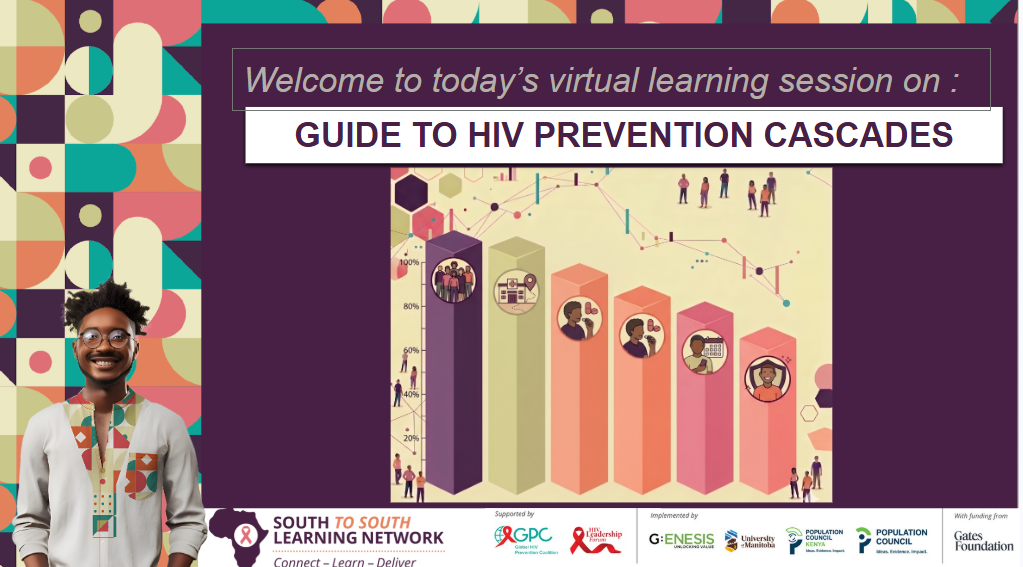
Interactive Learning Session on applying HIV prevention cascades for programmatic decision-making
Generic HIV prevention is no longer enough. With 1.3 million new infections in 2024, the global response is falling behind. Closing this gap demands data-driven, precision decision-making to optimise resources in a tightening funding landscape. Through the Tactical Prioritisation stream, the SSLN is focused on strengthening the uptake and practical application of existing tools for precision programming, with a particular emphasis on addressing real-world implementation challenges.
At the heart of this strategy are HIV Prevention Cascades. These frameworks map an individual's journey from awareness to consistent use of prevention methods, enabling stakeholders to identify critical gaps or leaks in the prevention continuum . The SSLN recently hosted an interactive skills building session to introduce the Guide to HIV Prevention Cascades, empowering country teams to use local data to solve local problems.
Key Highlights:
- Opening remarks & Setting the scene: Session chair Dr. Sanyukta Mathur (Population Council) opened the webinar by highlighting tactical prioritisation's role in pinpointing implementation gaps. She shared that precision programming ensures the right interventions reach the right people at the right time, moving beyond broad estimates to find those currently missed by the health system.
Dr. Mathur emphasised that precision programming allows country responses to reach the right populations with the right interventions at the right time. However, she noted that accurately identifying priority locations and sub-populations continues to be a significant challenge for programme managers. By using structured cascade frameworks, stakeholders can move beyond broad coverage estimates and focus directly on individuals who are being missed by the health system.
- Overview of Guide to HIV Prevention Cascades: Dr. Rediet Gebrehiwot (SSLN-i2i) then walked participants through the new guide. It serves as a consolidated toolkit to help teams navigate the variety of available models and select the right cascade for their specific data needs. The guide spotlights four key approaches:
- UNAIDS Basic Cascade: Examines how many people were reached by prevention methods, focusing on monitoring reach, coverage, uptake, and usage within specific populations.
- Effective Programme Coverage (EPC) Cascade: Assesses how many people were effectively covered by a prevention method, utilizing a programme science approach.
- Combination Prevention Cascade (CPC): Investigates where and why individuals drop out of the prevention cascade by systematically evaluating programme effectiveness.
- HIV continuum of care and treatment cascade (CoPCT) Cascade: Explores how the entire response system connects by tracking individual engagement across the continuum of care.
Dr. Gebrehiwot highlighted that for each of the four approaches, the guide offers standardised indicators, data requirement pathways, and adaptation steps to help users move seamlessly from data analysis to targeted action.
Country Presentation: Implementation Insights from Kenya and Zimbabwe
Country representatives from Kenya and Zimbabwe demonstrated how these frameworks drive policy and funding:
Kenya: Secondary Analysis of Key Population Data
Dr. Lilly Nyagah and Dr. Irene Mukui shared how Kenya used the EPC framework to reveal hidden gaps. While aggregate numbers looked good, the cascade showed MSMs face wider service gaps than FSWs due to stigma. Crucially, the steepest drop-off across all groups was in adherence. These insights are now shaping Kenya's Global Fund GC8 grant writing to route resources to specific local leaks.
Dr. Mukui explained that traditional, aggregate headline coverage numbers often mask significant service drop-offs. The cascade format, however, successfully revealed exactly where in the service pathway key populations are being lost. Their analysis brought forward several key findings:
- KP-Specific Bottlenecks: Due to structural stigma and limited access to Drop-in Centres (DICE), MSMs experience significantly wider gaps across all five indicators compared to FSWs. For example, current PrEP use stands at 52.1% for FSWs but falls to 38.2% for MSMs.
- The Adherence Gap: Across all indicators, the steepest drop-off occurred at the final adherence step (sustained, correct use over time). For instance, daily PrEP adherence drops to 38.4% among FSWs and 22.7% among MSMs, showing that the step that matters most is often the one least well measured.
- Geographic Disparities: National averages hid severe local inequities. Looking at HIV testing utilisation for young FSWs (ages 15–19), Kisumu County achieved an exceptional 100% across all steps due to strong DICE infrastructure. In contrast, Kiambu County experienced a systemic collapse, showing only 25% contact and utilization rates.
They also disclosed that these findings are being leveraged directly for Global Fund Grant Cycle 8 (GC8) grant writing. Rather than making broad budget requests, Kenya is using cascade data to justify county-specific funding allocations for lagging regions like Kiambu and Kajiado, routing resources precisely to the specific step where the leak occurs.
Zimbabwe: The Harare HIV Combination Prevention Cascade
- Mr. Ngwarai Sithole (Ministry of Health, Zimbabwe) showed how Zimbabwe used survey data to diagnose why people miss prevention. For example, slow PrEP uptake among young women was driven by low risk perception, while young men faced access barriers to VMMC. He urged global adoption of these cascades to standardise primary prevention measurement.
To solve this, Zimbabwe measured the core Harare HIV-CPC using data from the Zimbabwe Demographic and Health Survey (ZDHS 2023/24). By splitting the cascade into motivation, access, and effective use, the framework operates as an effective diagnostic tool.
Mr. Sithole detailed how the framework identified distinct barriers across demographics:
- Adolescent Girls and Young Women (AGYW): The cascade revealed that slow PrEP uptake among AGYW in Harare was primarily driven by a lack of perceived HIV risk, coupled with limited physical access.
- Young Men: Conversely, the uptake of voluntary medical male circumcision (VMMC) among young men was hindered primarily by low motivation, alongside systemic access barriers.
Mr. Sithole concluded by encouraging other countries to populate these combination cascades using their own DHS modules, and urged UNAIDS to formally adopt the Harare HIV-CPC format in global guidelines to standardize primary prevention measurement
- Interactive breakout session: The session wrapped with breakout rooms where participants were encouraged to share their personal experiences and challenges. Facilitators/speakers also had the opportunity to provide further guidance on the tools discussed.
Closing remarks:
Closing the session, Dr. Mathur reminded the participants that the recording and the Guide to HIV Prevention Cascades are available on the SSLN website to turn analysis into life-saving action.
Download Event Material