As donor funding contracts across Africa, responsibility for key population HIV service delivery is shifting toward national health systems. Key populations, including sex workers, men who have sex with men, transgender individuals, and people who inject drugs, face ongoing structural barriers to healthcare. Maintaining progress requires practical evidence on how existing service delivery models operate, which core functions drive effective coverage, and how transitions can occur without disrupting care.
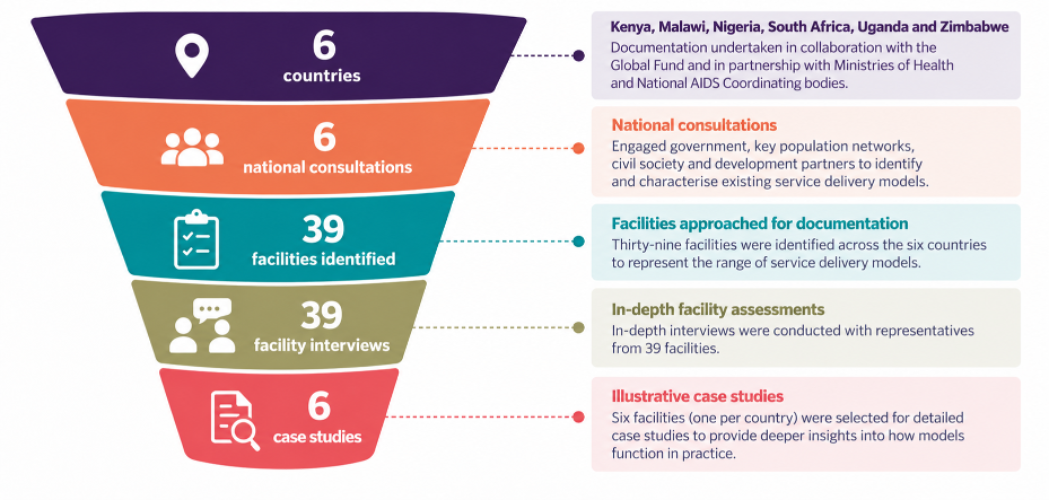
A documentation by the South to South Learning Network, Global Fund, Ministries of Health, National AIDS Councils and community networks documented service delivery models for key populations across Kenya, Malawi, Nigeria, South Africa, Uganda, and Zimbabwe. The analysis drew on information from six national consultations, in-depth interviews with 39 health facilities and six detailed case studies, guided by the World Health Organisation’s health systems framework. The findings reveal that countries use multiple service delivery models and highlight the importance of preserving essential functions to support effective coverage, irrespective of the model.
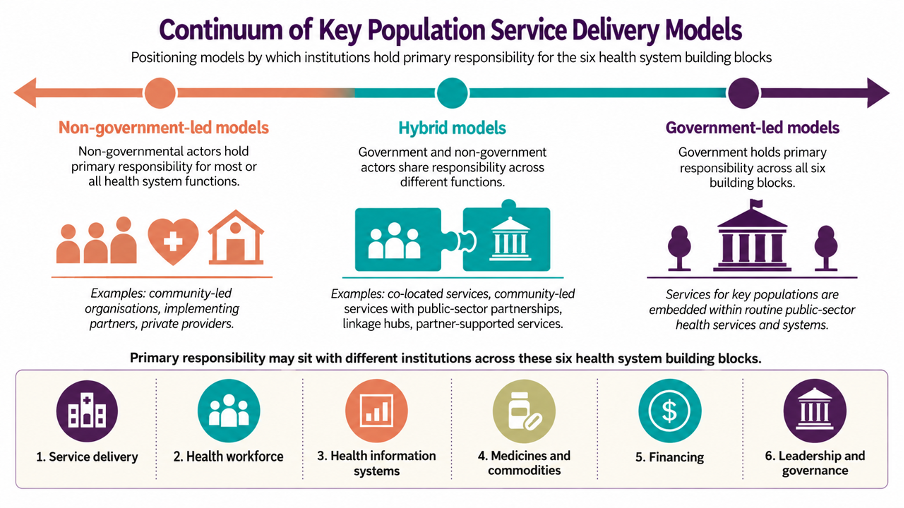
This documentation identifies three primary models along a continuum of institutional responsibility:
- Non-government-led models, including community-led organisations and social enterprise variants, support community trust and confidential access to tailored services, but rely heavily on external donor funding.
- Hybrid models share responsibilities across co-located units or linkage hubs, combining public infrastructure with specialised services and peer navigation to support access and continuity of care.
- Government-led models embed services within routine public clinics or dedicated health centres, offering opportunities for sustained delivery of services, provided that adequate workforce capacity and responsiveness to key populations are maintained.
This continuum is descriptive rather than a fixed transition pathway, as service integration can occur within any model.
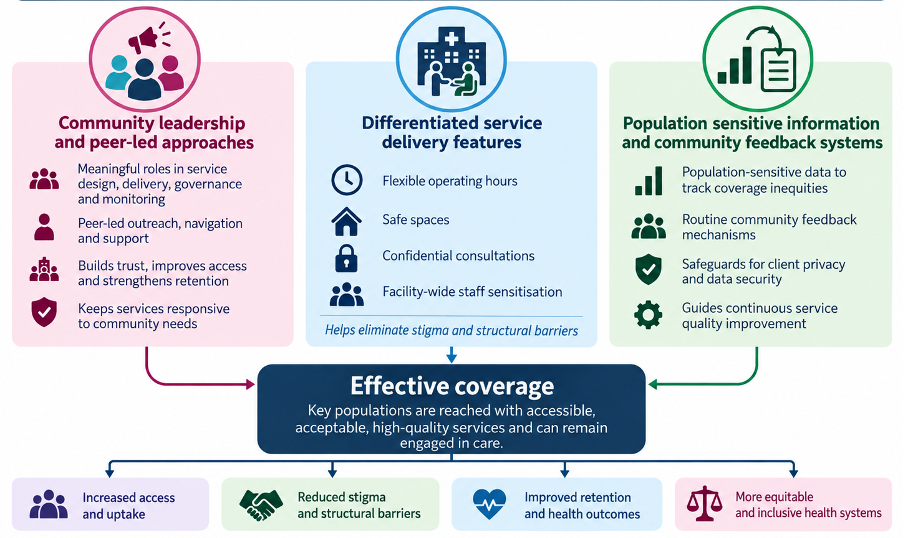
These key functions need to be protected:
Across all delivery models, achieving effective coverage depends on protecting core clinical and community facing functions that drive accessibility, acceptability, and trust. Meaningful community leadership and peer-led approaches are essential for extending outreach, building trust, supporting treatment adherence, and driving client retention. Differentiated service delivery features, including flexible operating hours, safe spaces, confidential consultations, and facility wide staff sensitisation, are necessary to eliminate stigma and structural barriers. Additionally, population sensitive health information systems and routine community feedback mechanisms must be maintained to track coverage inequities, safeguard client privacy, and guide continuous service quality improvements.
Findings from this work highlight key insights for stakeholders:
- National and Sub-National MoH: Maintain a complementary mix of service delivery models adapted to local population needs rather than enforcing a single model. Establish enabling policies and financing mechanisms to support non-governmental providers, and assess public health system readiness before shifting service-delivery responsibilities.
- Donors and Development Partners: Treat shifts in responsibility among institutions as planned transition investments rather than simple handovers. Protect financing for community systems and the specific functions that drive access, and support innovative financing approaches with strong equity safeguards.
- Implementing Partners: Incorporate sustainability into program design from grant inception rather than at closure. Align systems with government priorities while institutionalising and financing community leadership and peer cadres as core program functions.
- Key Population-Led Organisations: Use empirical evidence to advocate for complementary service delivery models that reflect population rights and needs. Define, cost, and protect community functions that drive effective coverage, and use evidence to strengthen accountability during transition decisions.
- SSLN: Leverage peer learning and through country learning agendas, share best practice in designing and adapting mixed service delivery models, and facilitate dedicated spaces for country champions to discuss transition and protection of key functions.